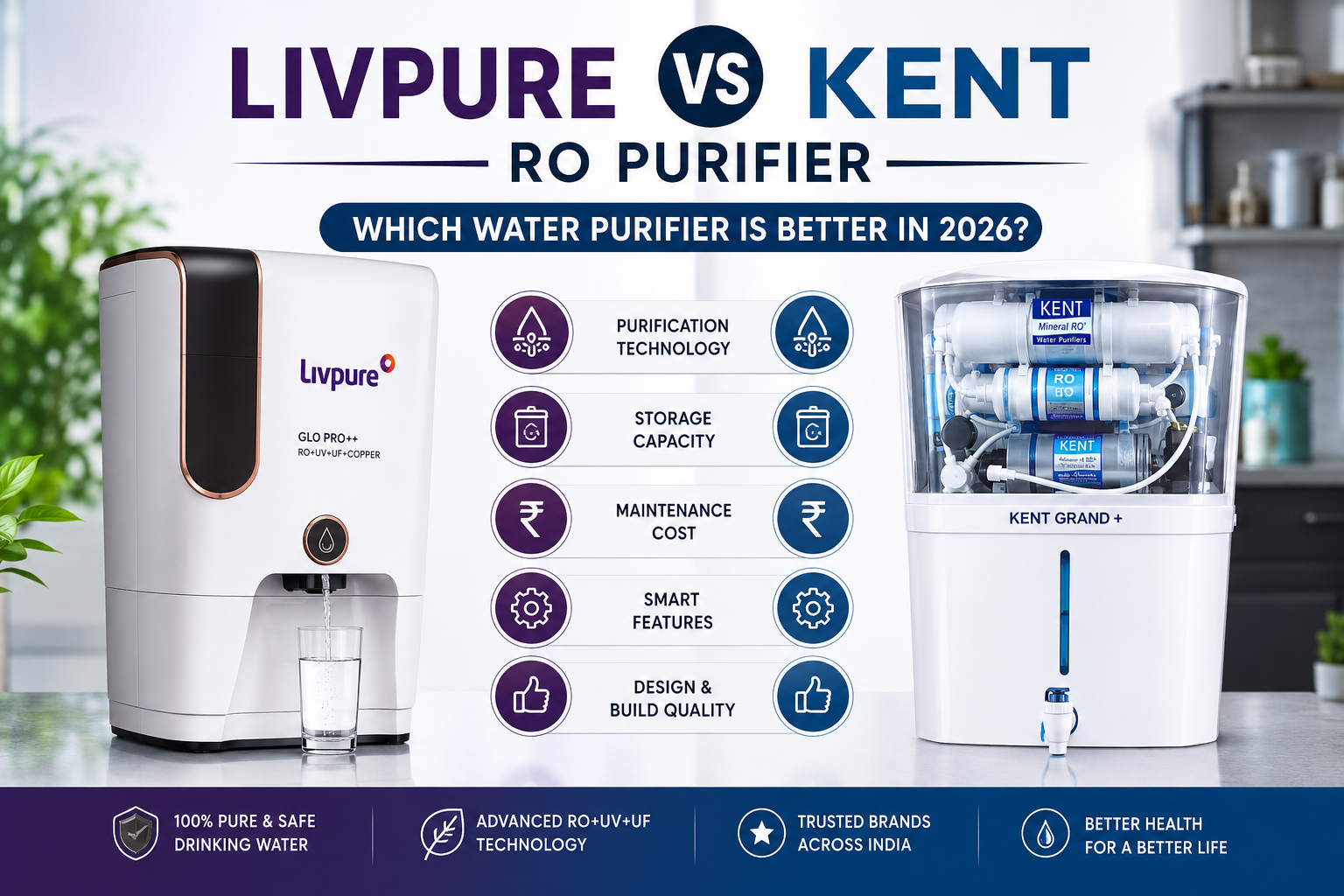
Buying a water purifier may appear easy but when it comes to brand comparison, things become really tough.
Words such as RO, UV, UF, copper enrichment, TDS controls, intelligent alerts, storage capacity and yearly maintenance fees come flooding. What appeared as an easy task becomes a complex one.
If you are faced with a Livpure vs Kent RO Purifier dilemma then there is no need to worry because you are not alone.
These two companies are some of the most reputable brands that provide quality water purification solutions in India with state-of-the-art technology, multiple products, and excellent customer services. They offer good solutions to all kinds of impurities from high-TDS borewell water to regular municipal water.
But the million dollar question here is:
Who is more worth your money?
This article will compare these two top brands in terms of price, purification technology, maintenance cost, design and other features.
Before choosing a purifier, it’s also smart to understand common issues buyers face. Check our guide on Common Water Purifier Problems and Solutions.
Why This Comparison Matters
Water quality varies drastically across India.
In cities, borewell water often has high TDS levels. In apartments, municipal water may contain chlorine and sediments. Some areas even deal with microbial contamination.
Choosing the wrong purifier is like buying winter clothes for summer—you’ll spend money but solve nothing.
That’s why comparing Livpure and Kent properly matters.
Quick Overview of Livpure and Kent
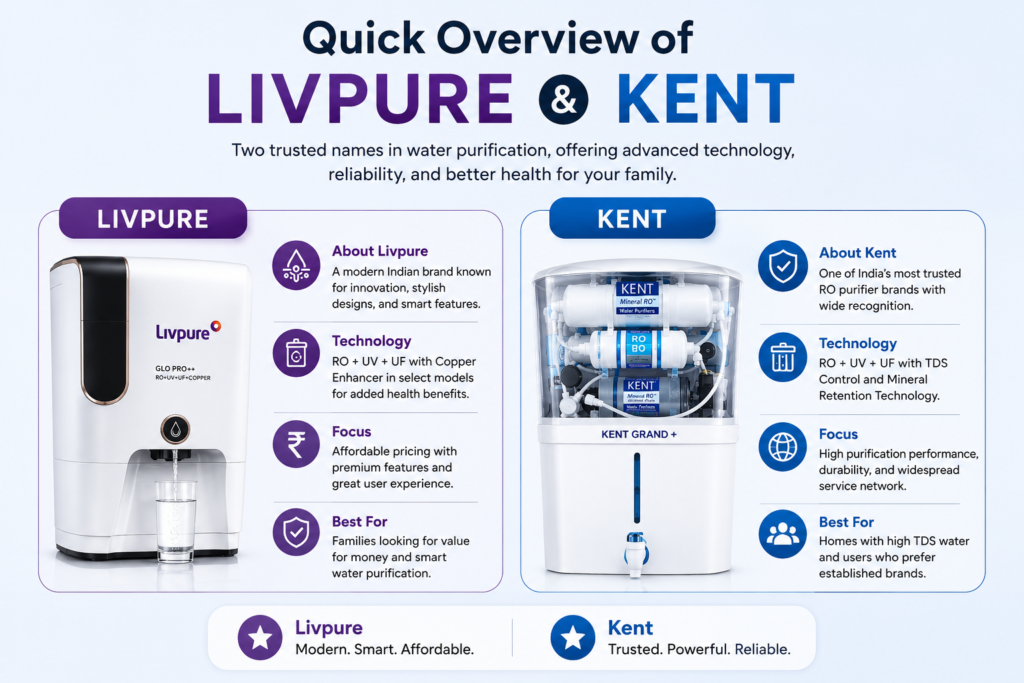
About Livpure
Livpure entered the Indian market as a relatively newer player but quickly gained popularity due to affordable pricing and stylish designs.
They focus on:
- RO + UV + UF purification
- Copper-enhanced purification
- Smart app features
- Budget-friendly models
Livpure is often seen as a value-for-money brand.
About Kent
Kent RO Systems is one of India’s most recognized water purifier brands.
Known for aggressive marketing and widespread service networks, Kent offers:
- Advanced RO systems
- Mineral RO technology
- Large service coverage
- Premium purifier models
Kent has stronger brand recognition in India.
Livpure vs Kent: Key Differences at a Glance
| Feature | Livpure | Kent |
|---|---|---|
| Price Range | Budget-friendly | Mid to premium |
| Technology | RO+UV+UF+Copper | RO+UV+UF+TDS Control |
| Design | Modern and compact | Functional but bulkier |
| Service Network | Growing | Wider |
| Smart Features | Better | Limited |
| Maintenance Cost | Moderate | Slightly expensive |
Purification Technology Comparison
RO Technology
Both brands use Reverse Osmosis technology to remove dissolved impurities, heavy metals, and excess TDS.
RO is ideal if your water TDS exceeds 300 ppm.
UV Technology
UV purification kills bacteria and viruses using ultraviolet light.
Both brands include this in many mid-range models.
UF Technology
UF helps remove fine particles without electricity.
This is useful as an extra purification layer.
Mineral Enhancement
Kent uses Mineral RO technology.
Kent RO Systems claims it retains essential minerals after purification.
Livpure offers copper-infused models that appeal to health-conscious buyers.
If you’ve experienced strange-tasting purified water before, read our guide on why RO water tastes bad and how to fix it.
Water Storage Capacity Comparison
Families often ignore storage capacity until guests arrive and purified water runs out.
Common capacities:
- Livpure: 7–8 liters
- Kent: 8–10 liters
Large families may prefer Kent.
Smaller households may find Livpure sufficient.
Design and Build Quality
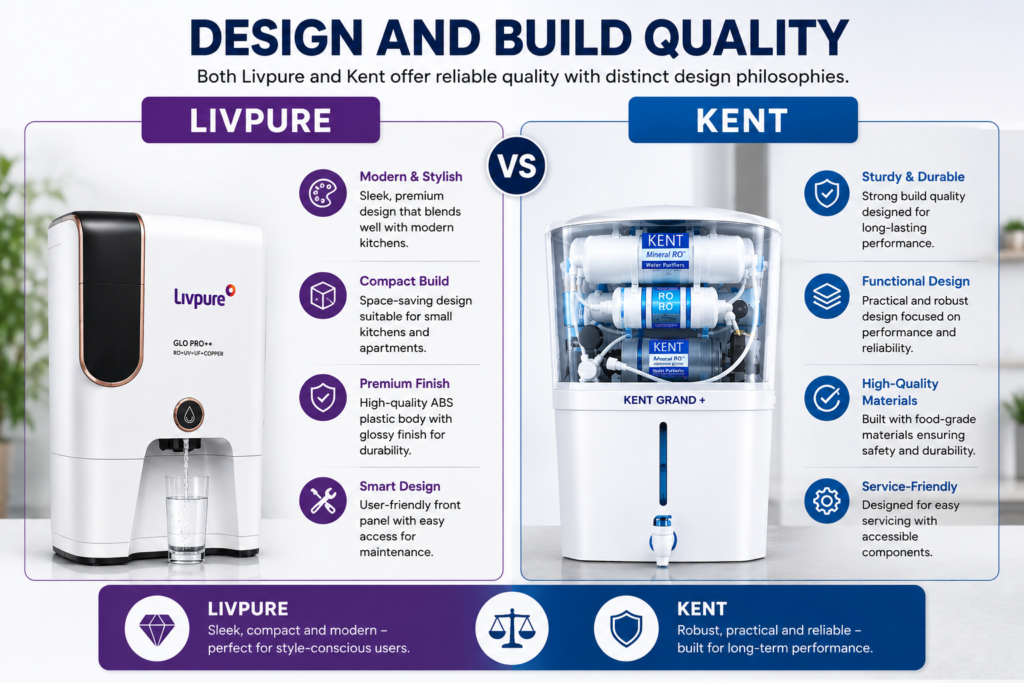
Livpure Design
- Livpure products look sleek and modern.
- They usually fit better in compact kitchens.
- Think of them as smartphones—clean, attractive, minimal.
Kent Design
- Kent models focus more on function than style.
- They can appear bulkier but often feel durable.
- Like an old SUV—it may not look flashy, but it gets the job done.
Smart Features and Technology
App Connectivity
- Some Livpure models include smart app tracking.
- Users can monitor filter life and service reminders.
Filter Alerts
Both brands offer filter replacement notifications on premium models.
Helpful? Absolutely.
Nobody wants to drink poorly filtered water unknowingly.
Maintenance and Filter Replacement Cost
This is where many buyers get surprised.
Initial cost is only half the story.
Livpure Maintenance Cost
Annual maintenance usually ranges between ₹3,000–₹5,000.
Kent Maintenance Cost
Kent filter replacement may cost slightly higher:
₹4,000–₹7,000 annually depending on usage.
Maintenance costs can rise if your purifier frequently stops working. Here’s what to do when your water purifier is not working properly.
Water Taste and Mineral Retention
One common complaint with RO systems?
Water sometimes tastes “flat.”
Kent RO Systems tries solving this through mineral retention technology.
Livpure uses copper technology in select models.
Taste preference often depends on your source water.
Electricity Consumption Comparison
RO purifiers require electricity.
Average annual usage:
- Livpure: Moderate
- Kent: Slightly higher for premium models
The difference won’t drastically impact your electricity bill.
Best Livpure Models
Livpure GLO PRO++
- Affordable
- RO+UV+UF
- Good for small families
Livpure Bolt+ Copper
- Copper infusion
- Stylish design
- Good storage capacity
Best Kent Models
Kent Grand Plus
- Mineral RO
- UV + UF
- Popular model
Kent Supreme Lite
- Compact design
- Good for apartments
Pricing Comparison
| Category | Livpure | Kent |
|---|---|---|
| Entry-Level | ₹8,000–₹12,000 | ₹10,000–₹15,000 |
| Mid-Range | ₹12,000–₹18,000 | ₹15,000–₹22,000 |
| Premium | ₹18,000+ | ₹20,000+ |
Livpure generally wins in affordability.
Kent wins in premium options.
Which Brand is Better for Hard Water?
If your home uses borewell water with high TDS:
- Kent RO Systems often performs better due to stronger RO systems.
- For moderate TDS municipal water:
- Livpure can be a more affordable choice.
Customer Reviews and Brand Reputation
- Kent has been around longer.
- It has stronger trust among older buyers.
- Livpure attracts younger customers looking for modern features.
- Both have mixed service reviews depending on location.
That’s common in India.
Pros and Cons of Livpure
Pros
- Affordable pricing
- Stylish design
- Smart features
- Good purification performance
Cons
- Smaller service network
- Fewer premium options
Pros and Cons of Kent
Pros
- Strong brand reputation
- Wide service availability
- Good high-TDS purification
Cons
- Higher maintenance cost
- Some models are expensive
Who Should Buy Livpure?
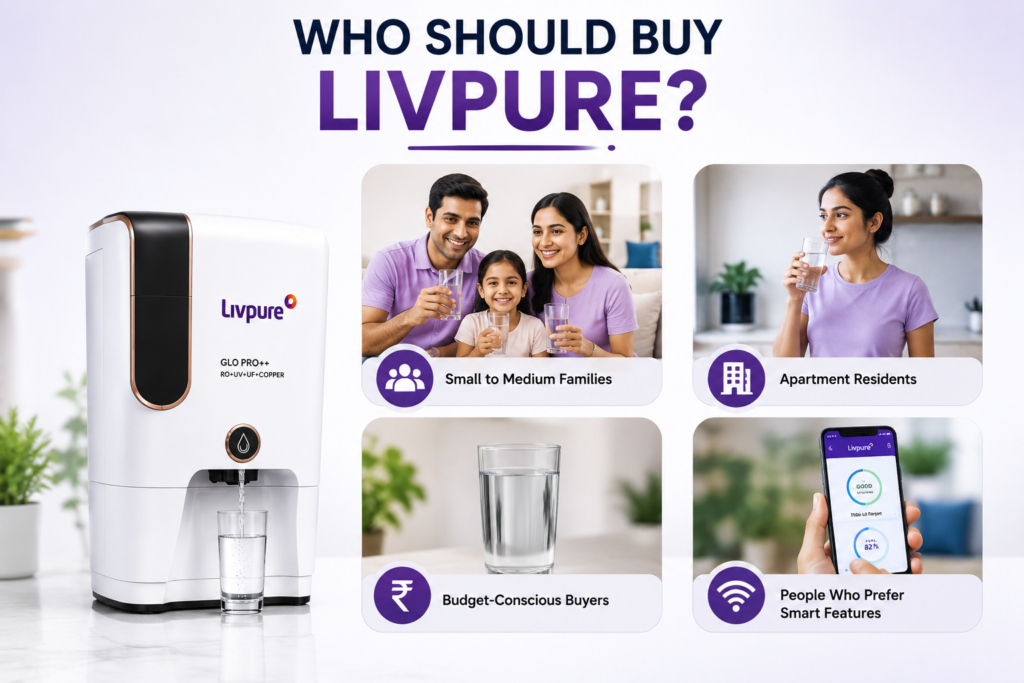
Choose Livpure if:
- You want budget-friendly options
- You live in an apartment
- You prefer modern features
- Your water TDS is moderate
Who Should Buy Kent?
Choose Kent if:
- Your water has high TDS
- You need stronger service support
- You want long-term brand reliability
Final Verdict
Here’s the honest answer:
- There’s no universal winner.
- Livpure is better for buyers who want affordability, smart features, and stylish design.
- Kent RO Systems is better for buyers dealing with high TDS water and looking for wider service support.
- Think of Livpure as a modern budget smartphone.
- Think of Kent as a reliable premium appliance.
- Your water source should decide your purchase—not just brand popularity.
FAQs
1. Which purifier is better for borewell water?
Kent usually performs better for high-TDS borewell water.
2. Is Livpure cheaper than Kent?
Yes, Livpure models are generally more affordable.
3. Does Kent retain minerals?
Yes, many Kent models include mineral retention technology.
4. Which brand has lower maintenance costs?
Livpure often has slightly lower maintenance expenses.
5. Is Livpure good for apartment use?
Yes, especially if your water source has moderate TDS levels.