Buying a water purifier sounds simple—until you start comparing brands.
Then suddenly, you’re drowning in terms like RO, UV, UF, copper technology, alkaline filters, TDS controllers, and storage capacity. And if you’re stuck between Kent and Aquaguard, you’re not alone.
These two brands dominate the Indian water purifier market, and both claim to provide safe drinking water. But here’s the real question:
Which one actually gives better value for your money?
That depends on your water source, budget, maintenance preference, and family size.
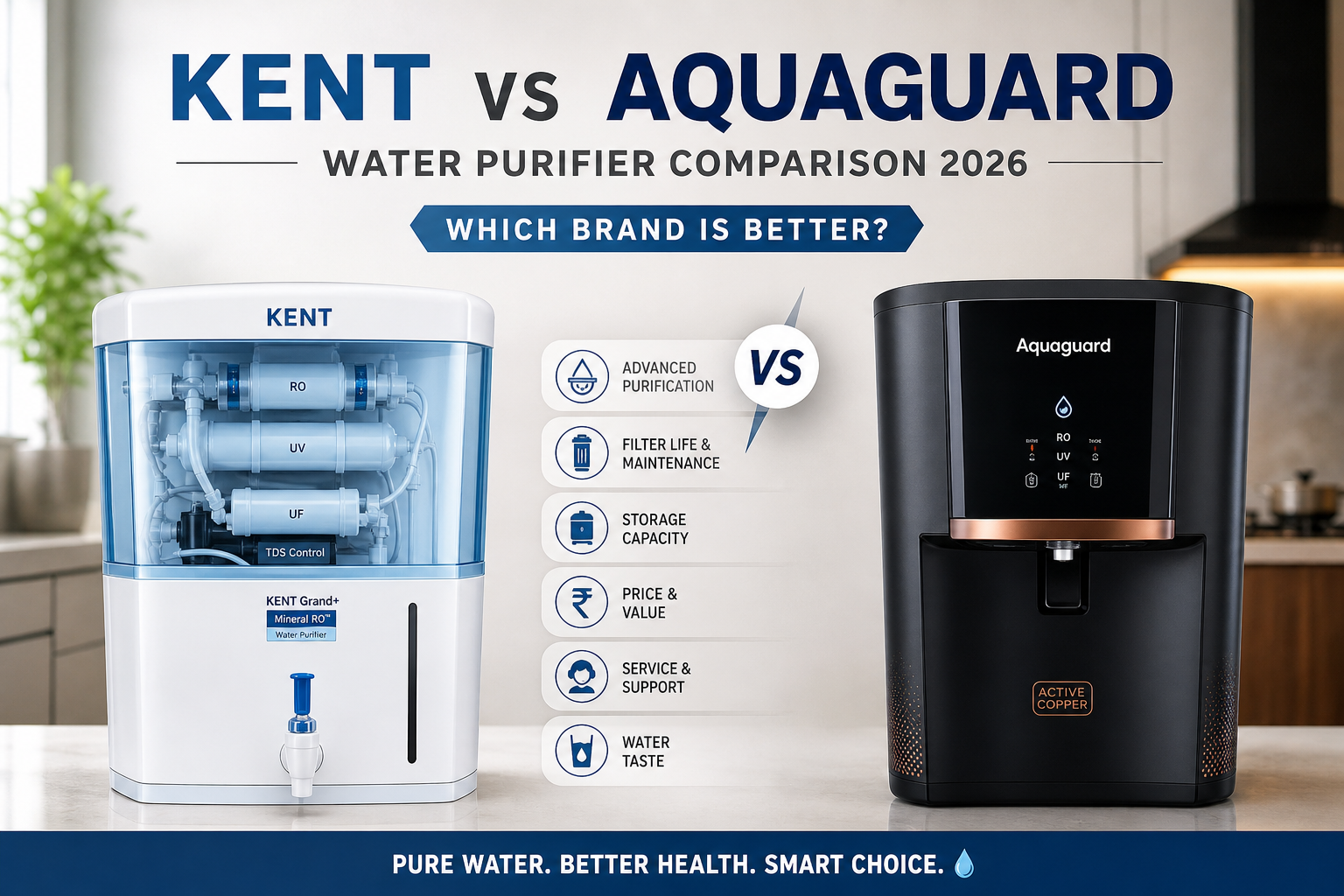
In this detailed comparison, we’ll break down everything you need to know about Kent vs Aquaguard water purifier models so you can make the right decision.
Why Kent and Aquaguard Are So Popular in India
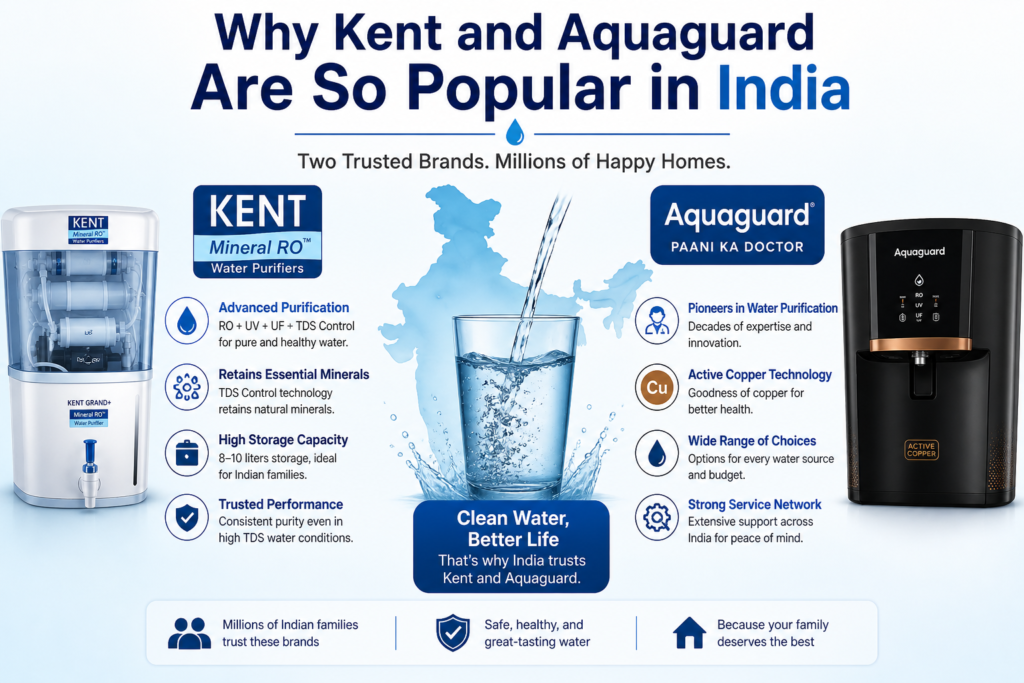
When people think of water purifiers in India, two names often pop up first:
- Kent RO Systems
- Aquaguard
Why?
Because both brands have been around for years and have built strong trust among Indian households.
Kent became popular because of its RO+UV+UF combinations and mineral retention technology.
Aquaguard, owned by Eureka Forbes, gained popularity through its extensive service network and wide product range.
Think of them like Samsung vs LG in home appliances—both are strong, but each has different strengths.
Overview of Kent Water Purifiers
Kent mainly focuses on RO purifiers and is widely chosen in areas where water has high TDS levels.
Popular Kent Models
Some popular models include:
- Kent Grand Plus
- Kent Supreme Plus
- Kent Elegant Copper
- Kent Excell Plus
Key Features of Kent
RO + UV + UF Purification
Kent combines multiple purification stages. KENT Purification Technology Guide
TDS Controller
Helps retain essential minerals.
Large Storage
Most models offer 8–10 liters storage.
Wall-Mounted Designs
Ideal for Indian kitchens.
Overview of Aquaguard Water Purifiers
Aquaguard offers both budget and premium water purifier models.
Popular Aquaguard Models
Popular options include:
- Aquaguard Aura
- Aquaguard Ritz
- Aquaguard Marvel
- Aquaguard Blaze
Key Features of Aquaguard
Active Copper Technology
Adds copper-infused water.
Taste Adjuster
Improves taste based on water source.
Smart Indicators
Filter replacement alerts.
Sleek Designs
Often looks more premium.
Kent vs Aquaguard: Purification Technology Comparison
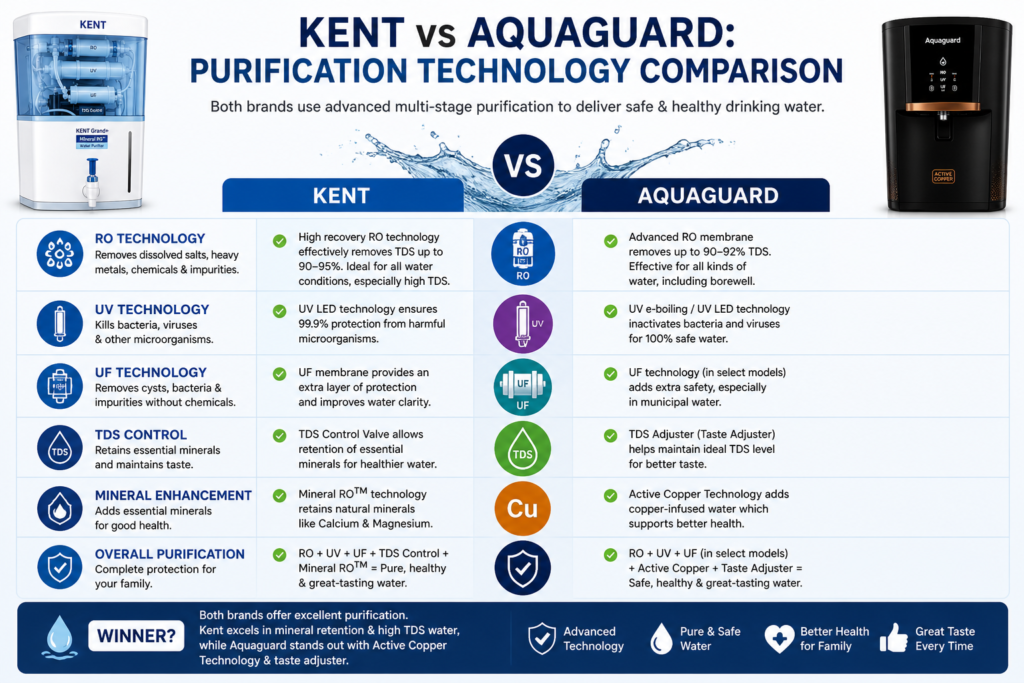
This is where things get interesting.
RO Technology
RO+UV+UF
Both brands offer RO systems.
Kent performs slightly better in extremely high TDS areas.
Aquaguard also handles high TDS but varies by model.
UV Technology
UV kills bacteria and viruses.
Both brands perform similarly here.
UF Technology
Useful during power cuts since UF can work without electricity in certain models.
Kent often bundles this feature.
TDS Control
Kent is known for stronger TDS control features.
This helps preserve healthy minerals after purification. RO systems can sometimes face water flow issues—here’s how to fix no water flow problems in RO purifiers.
Water Storage Capacity Comparison
For large families, storage matters.
| Brand | Average Storage |
|---|---|
| Kent | 8–10 Liters |
| Aquaguard | 6–9 Liters |
If your family consumes a lot of water daily, Kent often wins here.
Design and Build Quality
Aquaguard usually feels more premium in terms of aesthetics.
Kent focuses more on functionality.
If kitchen appearance matters to you, Aquaguard may look more modern.
Filter Life and Maintenance Costs
This is often ignored during purchase—but becomes important later.
Kent Maintenance Cost
Annual maintenance may cost ₹3,000–₹6,000 depending on usage.
RO membrane replacements can be expensive.
Aquaguard Maintenance Cost
Aquaguard also has similar maintenance costs.
However, their service plans are often more widely available. If you want to understand common purifier maintenance issues, check out our guide on common water purifier problems and solutions.
Installation and Customer Service
Aquaguard has a larger offline service network across India.
Kent also provides installation support but availability may vary in smaller towns.
If you live in a metro city, both should work fine.
If you live in a smaller town, Aquaguard may have an edge.
Kent vs Aquaguard Price Comparison
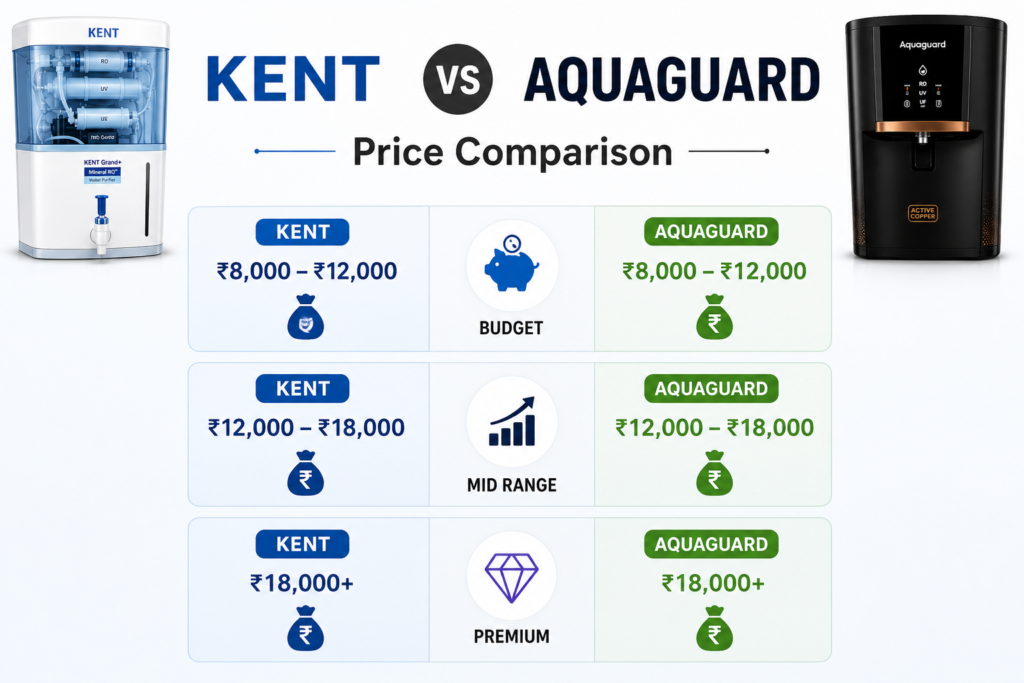
Budget Segment: ₹8,000–₹12,000
Aquaguard has more options.
Mid Range: ₹12,000–₹18,000
Both brands compete strongly.
Premium Segment: ₹18,000+
Aquaguard often offers more premium designs.
Which Is Better for Borewell Water?
Borewell water usually has high TDS.
Kent often performs better here because of strong RO purification.
If your water tastes salty or leaves white marks on utensils, Kent may be a safer bet. Low pressure is common in RO systems using borewell water—learn how to fix RO water purifier low pressure problems.
Which Is Better for Municipal Water?
Municipal water often has lower TDS.
Aquaguard UV/UF models can be sufficient and save water compared to RO systems.
Kent Water Purifier Pros and Cons
Pros
- Excellent RO purification
- Great for high TDS water
- Large storage capacity
- Strong mineral retention
Cons
- Design feels basic
- Service network may vary by location
Aquaguard Water Purifier Pros and Cons
Pros
- Better design
- Strong customer service network
- More variety in product lineup
- Smart features available
Cons
- Some premium models are expensive
- Filter replacements can add up over time
Which One Should You Buy?
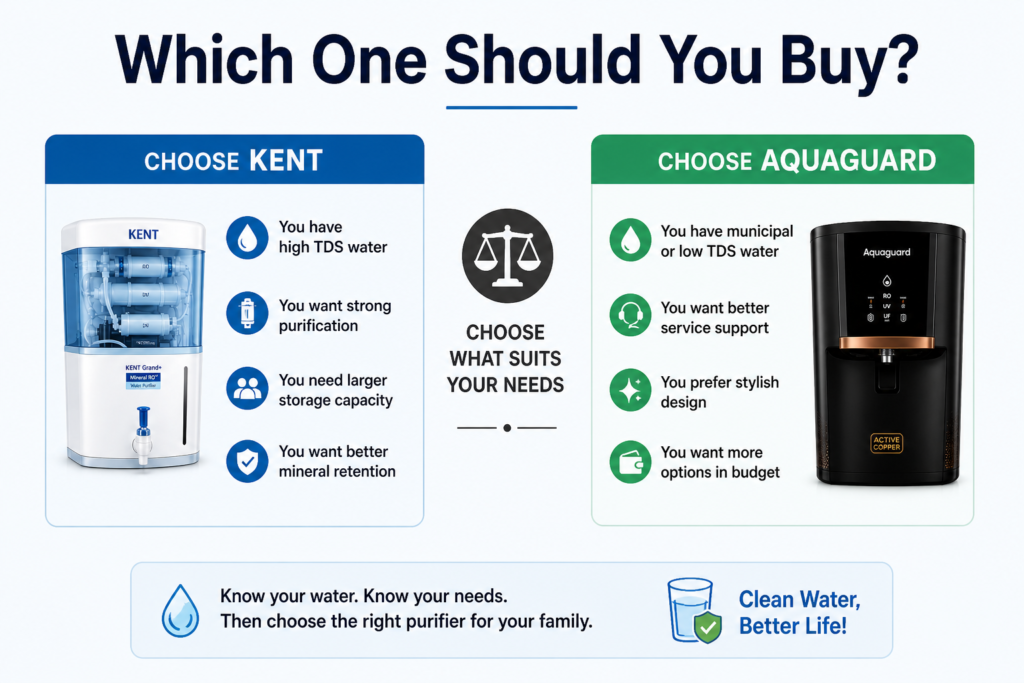
Choose Kent if:
- You use borewell water
- Your TDS is high
- You want strong purification performance
Choose Aquaguard if:
- You want stylish design
- You need better service access
- You use municipal water
It’s like choosing between a rugged SUV and a luxury sedan—depends on your needs.
Final Verdict
So, Kent vs Aquaguard water purifier—which wins?
There’s no universal winner.
If your priority is heavy-duty purification, go with Kent RO Systems.
If you want better design and broader service support, choose Aquaguard.
Before buying, always test your water’s TDS level. That one small step can save you from buying the wrong purifier.
Clean water isn’t a luxury—it’s survival.
Choose wisely.
FAQs
1. Which purifier is better, Kent or Aquaguard?
Kent is better for high TDS water, while Aquaguard is better for design and service support.
2. Is Kent maintenance expensive?
It can cost ₹3,000–₹6,000 annually depending on usage.
3. Does Aquaguard remove TDS?
Yes, RO models reduce TDS effectively.
4. Which purifier is best for borewell water?
Kent usually performs better for borewell water.
5. Which purifier lasts longer?
Both can last many years with proper maintenance.