Water looks simple, doesn’t it? Clear, refreshing, and essential for everyday life. But have you ever wondered what is TDS in water and why it matters so much for drinking water quality? Beneath that crystal-clear appearance lies a hidden mix of minerals, salts, metals, and microscopic substances. That’s where TDS comes into the picture.
If you’ve ever searched for a water purifier, you’ve probably come across terms like “TDS controller,” “high TDS water,” or “TDS meter.” But what exactly is TDS in water? Is high TDS dangerous? Is low TDS always better? And why do people pay so much attention to TDS levels when choosing a water purifier?
Let’s break down everything you need to know about TDS in water in the simplest way possible.
If you’re confused about which purification technology is best for your water quality, you can also read our detailed comparison on RO vs UV vs UF Water Purifier to understand which system works best for different TDS levels.
Understanding TDS
What Does TDS Stand For?
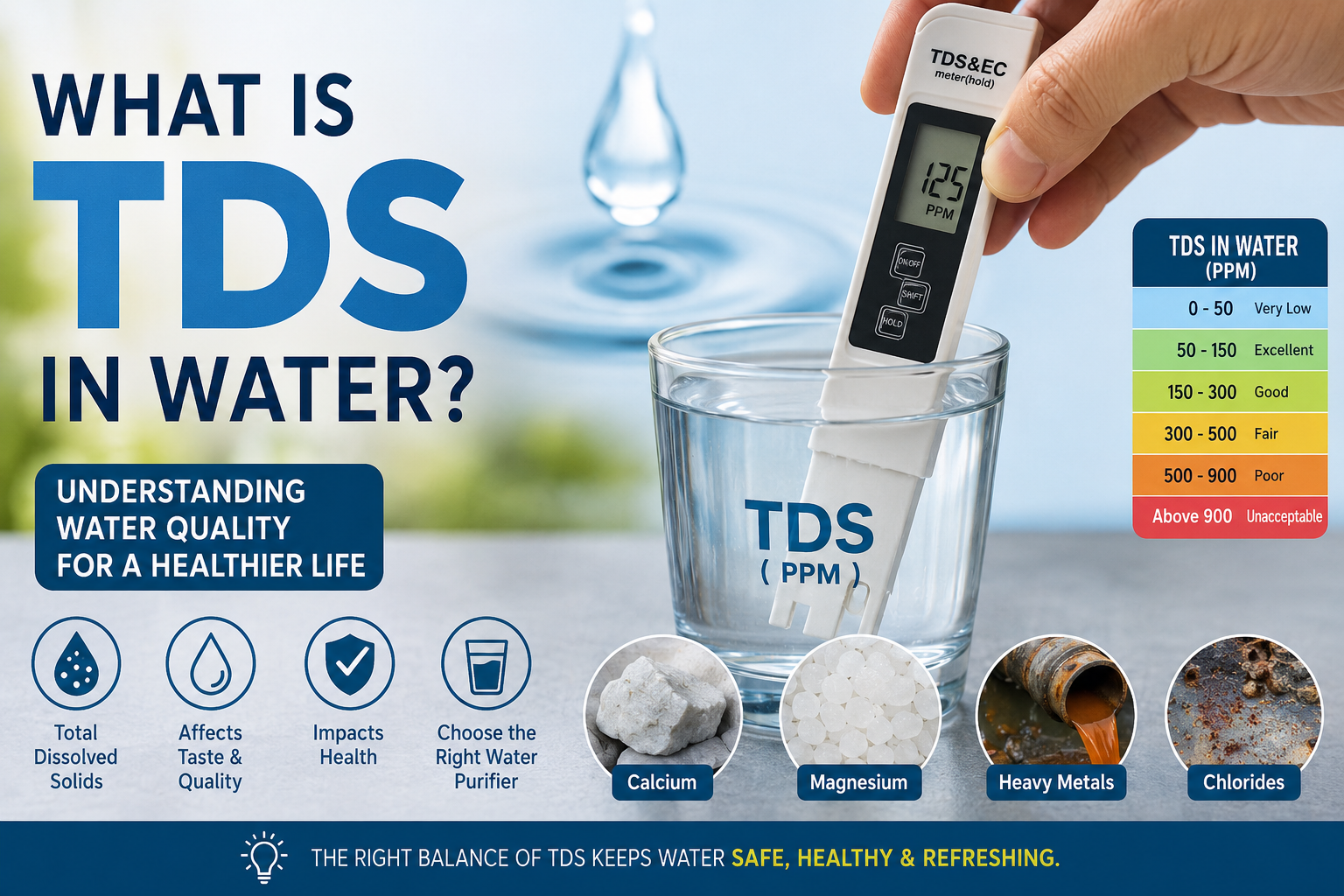
TDS stands for Total Dissolved Solids. It refers to the total amount of dissolved substances present in water.
These dissolved solids may include:
- Minerals
- Salts
- Metals
- Organic matter
- Ions
Think of water like a cup of tea. Once sugar dissolves into it, you can’t see the sugar anymore—but it’s still there. Similarly, many substances dissolve in water invisibly, contributing to the TDS level.
Why TDS Matters in Daily Life
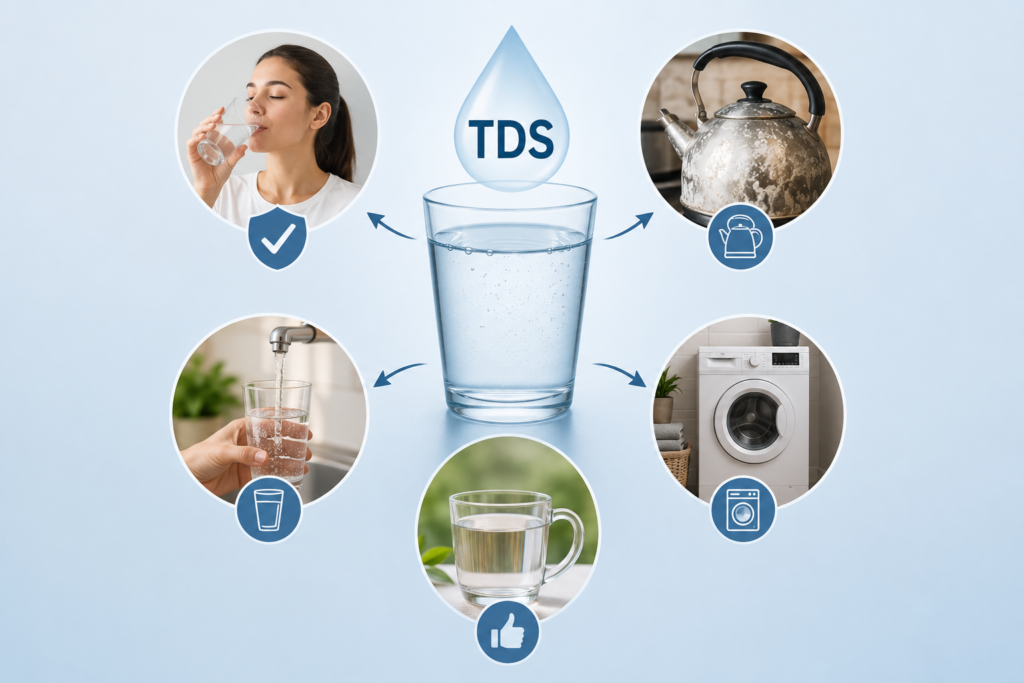
TDS plays a huge role in determining the:
- Taste of water
- Water quality
- Suitability for drinking
- Performance of water purifiers
- Health impact over time
Water with the right TDS level often tastes fresh and pleasant. But when the TDS becomes too high or too low, problems can begin.
It’s a bit like seasoning in food. Too little makes it bland. Too much ruins the dish.
What Makes Up TDS in Water?
Minerals in Water
Not all dissolved solids are harmful. In fact, some are beneficial.
Common healthy minerals found in water include:
- Calcium
- Magnesium
- Potassium
- Sodium
These minerals naturally enter water through rocks and soil. They can even contribute to your daily mineral intake.
For example, groundwater often contains calcium and magnesium, which make water “hard.”
Harmful Contaminants
Unfortunately, TDS can also include harmful substances such as:
- Lead
- Arsenic
- Mercury
- Pesticides
- Industrial chemicals
- Nitrates
This is why simply knowing the TDS number isn’t enough. A high TDS level could mean healthy minerals—or dangerous contamination.
That’s why proper water testing matters.
How Is TDS Measured?
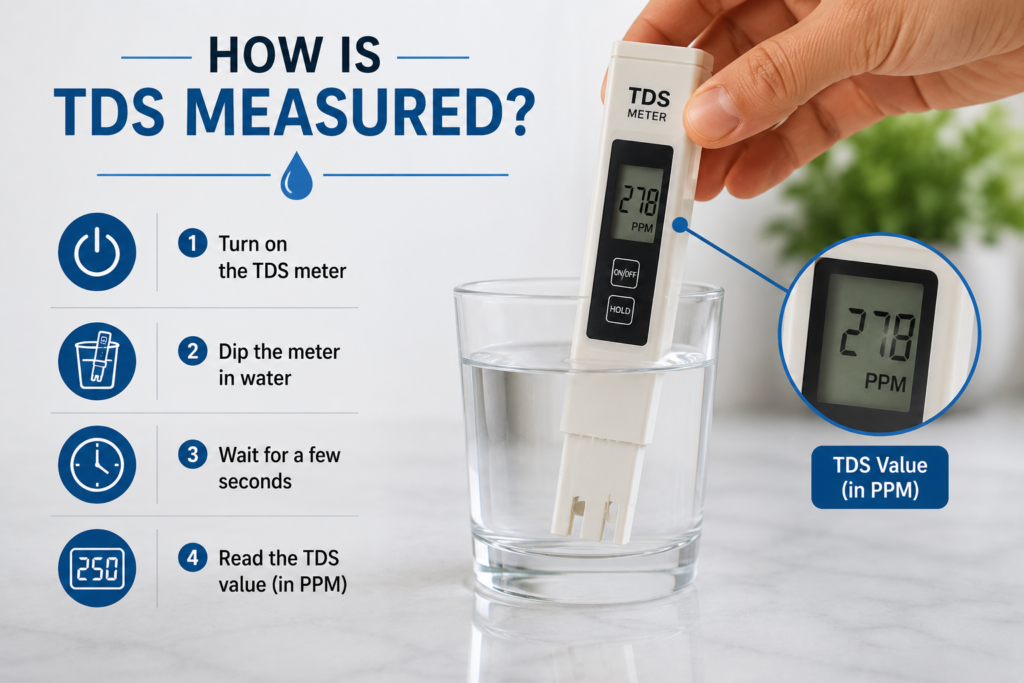
TDS Meter Explained
A TDS meter is a small device used to measure dissolved solids in water.
It works by checking the electrical conductivity of water. Since dissolved minerals conduct electricity, the meter estimates the TDS level based on conductivity.
Using one is incredibly simple:
- Turn on the meter
- Dip it into water
- Wait a few seconds
- Read the result
It’s almost like checking your body temperature with a thermometer.
TDS Measurement Unit
TDS is measured in:
- PPM (Parts Per Million)
- Sometimes mg/L (milligrams per liter)
For example:
- 100 PPM means 100 parts of dissolved solids per million parts of water.
The higher the PPM, the more dissolved substances are present.
You can also use a digital TDS meter at home to quickly measure the dissolved solids in your drinking water.
Ideal TDS Level for Drinking Water
WHO and BIS Guidelines
According to general drinking water standards:
| TDS Level (PPM) | Water Quality |
|---|---|
| Below 50 | Very low |
| 50–150 | Excellent |
| 150–300 | Good |
| 300–500 | Fair |
| 500–900 | Poor |
| Above 900 | Unsuitable |
In India, the desirable TDS level for drinking water is generally considered below 500 PPM.
However, many people prefer water between 100–300 PPM because it tastes balanced and contains essential minerals.
In India, the Bureau of Indian Standards (BIS) recommends acceptable TDS limits for safe drinking water consumption.
High TDS vs Low TDS Water
Effects of High TDS Water
High TDS water may:
- Taste salty or bitter
- Cause scaling in appliances
- Leave white stains on taps
- Affect water purifier performance
In extreme cases, it may also contain harmful contaminants.
Imagine boiling hard water repeatedly and seeing white deposits inside the kettle—that’s often due to high dissolved solids.
Effects of Low TDS Water
Very low TDS water may:
- Taste flat or bland
- Lack essential minerals
- Feel unusually light
RO purifiers sometimes reduce TDS too much, which is why many modern purifiers include mineral boosters or TDS controllers.
Water without minerals is like eating plain rice without salt—it works, but it doesn’t feel satisfying.
Sources of TDS in Water
Natural Sources
Nature itself adds dissolved solids into water.
Common natural sources include:
- Rocks
- Soil
- Underground minerals
- Rivers and lakes
As water travels underground, it dissolves tiny mineral particles along the way.
That’s why borewell water often has higher TDS than municipal water.
Human-Made Sources
Human activities can also increase TDS levels.
Examples include:
- Industrial waste
- Agricultural fertilizers
- Sewage discharge
- Chemical runoff
This is where water pollution becomes dangerous. Harmful dissolved chemicals may enter drinking water supplies unnoticed.
How to Reduce TDS in Water
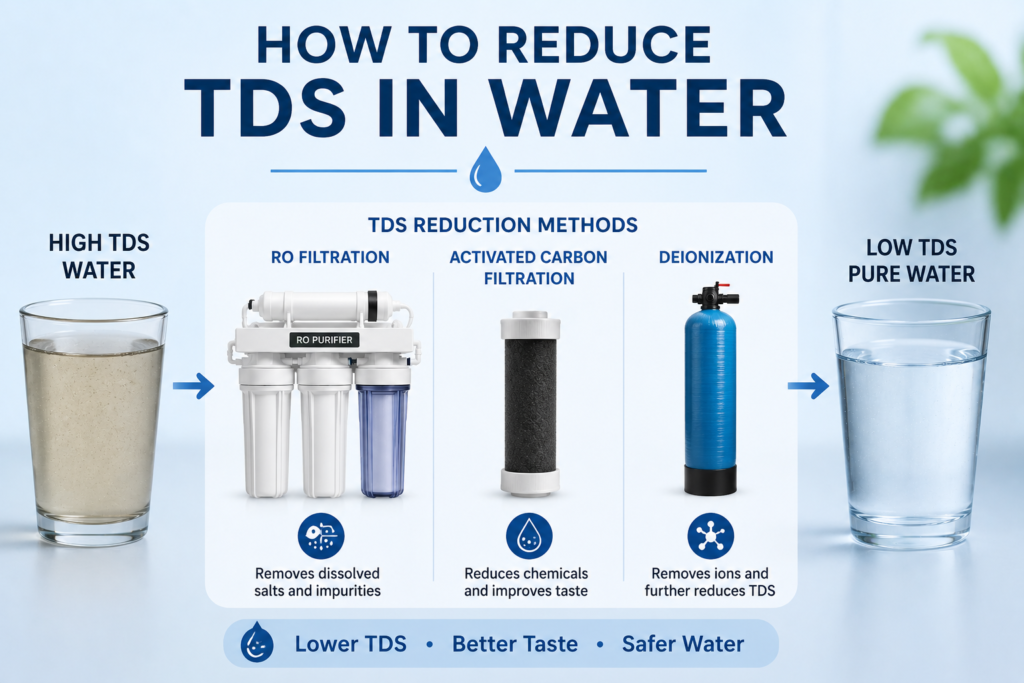
RO Water Purifiers
Reverse Osmosis (RO) is the most common method used to reduce high TDS.
An RO membrane removes:
- Dissolved salts
- Heavy metals
- Harmful contaminants
RO purifiers are especially useful for:
- Borewell water
- Hard water
- High TDS water above 300–500 PPM
However, RO also removes some healthy minerals.
That’s why choosing a purifier with a mineralizer can help maintain balanced drinking water.
If you’re planning to buy a purifier for high TDS water, check our guide on the Best Water Purifier Under 10000 for budget-friendly options suitable for Indian homes.
Distillation and Deionization
Other methods include:
Distillation
Water is boiled into steam and condensed back into liquid form, leaving impurities behind.
Deionization
Special resins remove charged ions from water.
These methods are effective but less common in households due to cost and practicality.
Does Low TDS Mean Pure Water?
Absolutely not.
This is one of the biggest misconceptions.
Low TDS only means fewer dissolved solids. It does not guarantee that water is safe.
For example:
- Harmful bacteria may still exist
- Viruses may still survive
- Chemical contamination may still be present
Similarly, mineral-rich water can have slightly higher TDS while still being healthy.
So TDS is only one piece of the puzzle.
TDS and Water Taste
Ever noticed how water tastes different in different places?
That’s largely due to TDS.
- Low TDS water tastes flat
- Moderate TDS water tastes refreshing
- High TDS water tastes salty or metallic
Minerals like calcium and magnesium improve flavor to some extent. That’s why natural spring water often tastes better than distilled water.
Taste is like music—balance matters more than extremes.
Can You Drink High TDS Water?
It depends on what’s causing the high TDS.
If the dissolved solids are mainly healthy minerals, moderately high TDS may not be dangerous.
But if the TDS comes from:
- Heavy metals
- Industrial chemicals
- Contaminants
then it becomes unsafe.
This is why water testing is essential instead of relying only on the TDS number.
Choosing the Right Water Purifier Based on TDS
Here’s a simple guide:
| Water Type | Recommended Purifier |
|---|---|
| Low TDS municipal water | UV + UF purifier |
| Moderate TDS water | RO + UV purifier |
| High TDS borewell water | RO + UV + Mineralizer |
| Microbiologically unsafe water | UV purification needed |
Before buying a purifier, test your water’s TDS level first.
Buying the wrong purifier is like wearing a raincoat in summer—it may not solve the real problem.
If you’re comparing popular purifier brands before buying, these detailed comparisons can help you choose the right option based on water quality, maintenance, and budget.
Common Myths About TDS
Myth 1: Higher TDS Means Better Water
Not always. High TDS can indicate contamination.
Myth 2: RO Water Is Always Healthiest
RO water can become too low in minerals if over-purified.
Myth 3: TDS Measures Germs
False. TDS does not measure bacteria or viruses.
How Often Should You Check TDS?
You should ideally check your water:
- Every few months
- After installing a purifier
- When water taste changes
- During seasonal changes
Regular testing helps ensure your purifier is working properly.
Signs Your Water Has High TDS
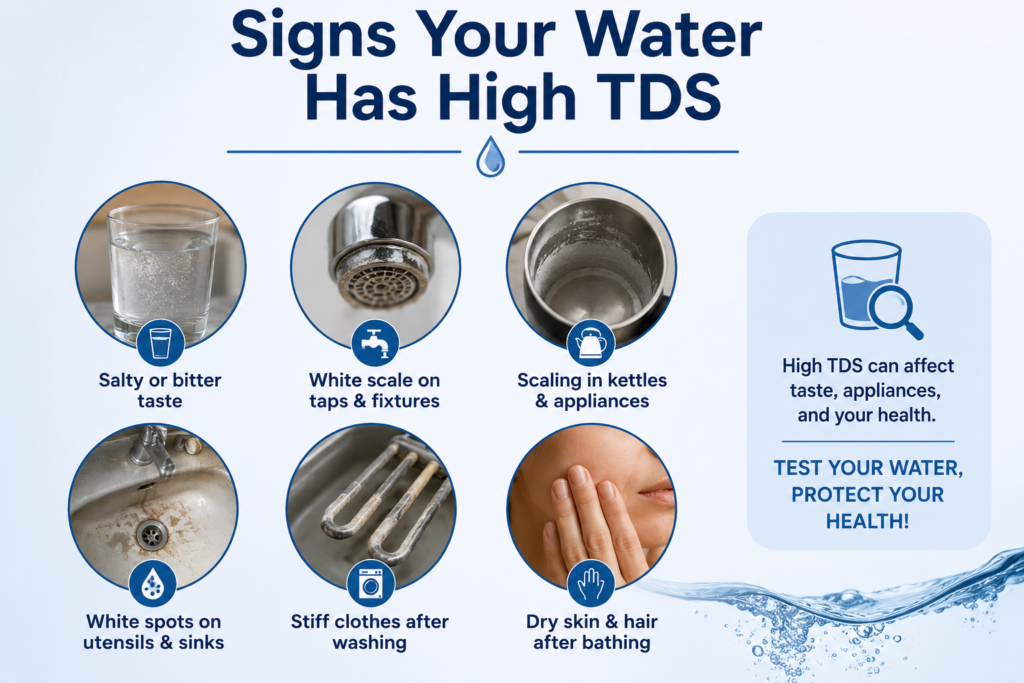
Watch for these warning signs:
- Salty taste
- White scale buildup
- Dry skin after bathing
- Stiff laundry
- Spots on utensils
These symptoms often point toward hard water or high dissolved solids. According to the World Health Organization (WHO), drinking water quality should be monitored carefully to ensure safety, taste, and mineral balance.
Conclusion
TDS in water may sound technical, but the concept is actually simple. It represents the dissolved substances floating invisibly in your water—some beneficial, some potentially harmful.
The key is balance.
Too much TDS can affect taste, appliances, and health. Too little may remove useful minerals and leave water tasting lifeless. Understanding your water’s TDS level helps you choose the right purifier and maintain safer drinking water for your family.
At the end of the day, clean water isn’t just about clarity—it’s about what you can’t see.
FAQs
1. How Much TDS Is Safe in Water?
A TDS level between 50–300 PPM is generally considered ideal for drinking water. According to BIS standards in India, water with TDS up to 500 PPM is acceptable for regular consumption.
2. What Is the TDS of RO Water?
RO water usually has a TDS level between 20–150 PPM, depending on the purifier and source water. Many modern RO purifiers add essential minerals back into the water for better taste and health balance.
3. Is RO Required for 200 TDS Water?
Not always. If your water has around 200 TDS and is microbiologically safe, a UV or UF purifier may be enough. RO is mainly recommended for high TDS water above 300–500 PPM.
4. What Is the TDS of Bisleri 1 Litre Water?
The TDS of Bisleri bottled water typically ranges between 75–150 PPM, depending on the source and purification process.
5. What Is the TDS of Kinley Water?
The TDS level of Kinley drinking water usually falls between 80–150 PPM, offering balanced taste and mineral content.
6. What Happens If TDS Is Too High in Water?
Very high TDS water may taste salty or bitter and can contain excess minerals, heavy metals, or contaminants. It may also cause scaling in kitchen appliances and plumbing systems.